


Reflective Panels in Lighting: Enhancing Healing and Efficiency
- Dimitri

- Dec 24, 2025
- 8 min read
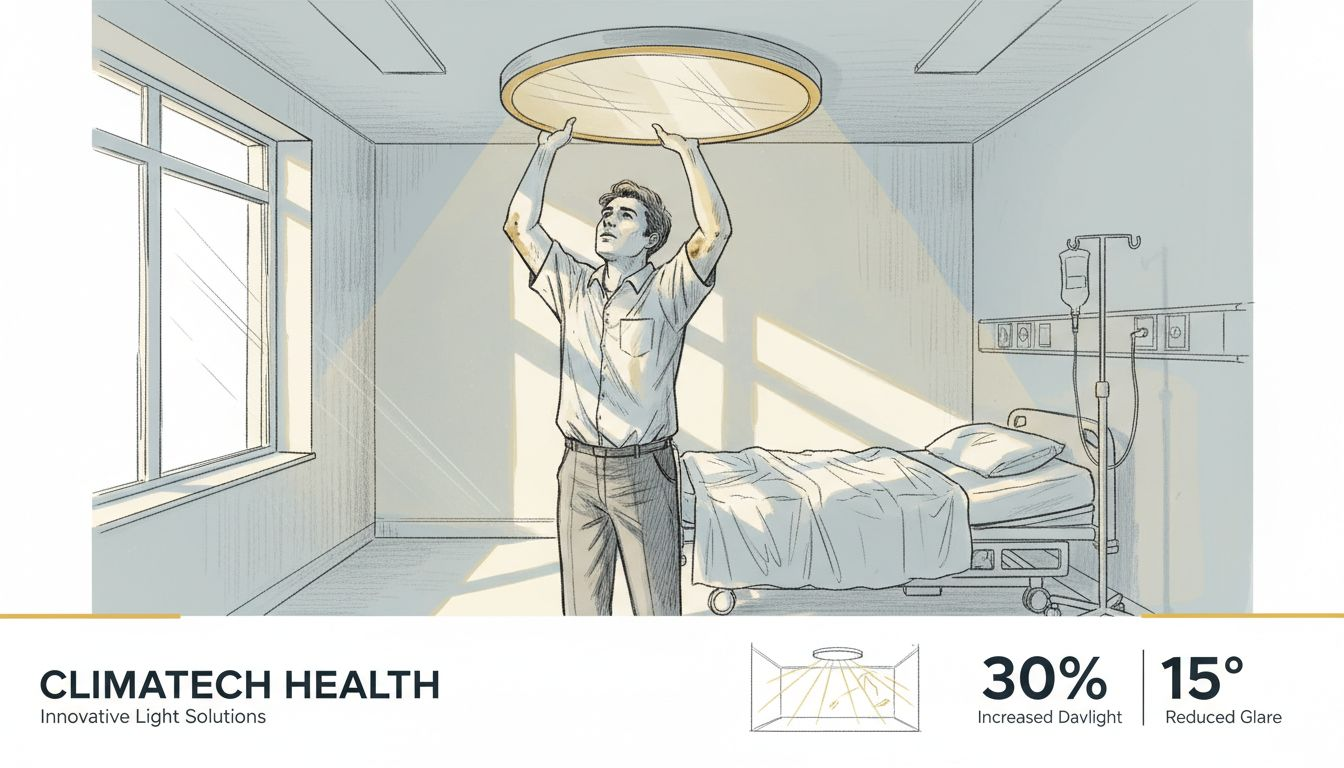
Many British healthcare facilities are discovering that traditional light fixtures leave both patients and budgets in the dark. With up to 70 percent lower reliance on artificial lighting using advanced reflective panels, the opportunity to harness natural sunlight is reshaping recovery and reducing running costs. For healthcare facility managers across European countries, understanding these technologies and separating myths from proven strategies means brighter spaces, satisfied patients, and a clear path toward energy-smart sustainability.
Table of Contents
Key Takeaways
Point | Details |
Reflective Panels Enhance Light Use | Reflective panels efficiently redirect and optimise natural light in architectural spaces, improving interior environments in healthcare facilities. |
Affordability and Accessibility | Contrary to common myths, modern reflective panel solutions are cost-effective and feature modular installation processes. |
Impact on Health and Energy | Advanced reflective technologies can reduce energy consumption by up to 70% while significantly improving patient well-being and recovery outcomes. |
Holistic Design Approach Necessary | Successful implementation requires interdisciplinary collaboration, addressing architectural constraints, patient needs, and compliance with regulations. |
What Are Reflective Panels And Myths
Reflective panels represent sophisticated light manipulation technologies designed to redirect, enhance, and optimise natural illumination within architectural spaces. These innovative systems use precise optical engineering principles to capture, redirect, and distribute sunlight effectively. By understanding how optical prisms manipulate light through reflection and refraction, healthcare facility managers can transform interior environments.
At their core, reflective panels operate through advanced physics principles that involve redirecting light waves with minimal energy loss. Unlike traditional window designs, these panels can capture sunlight from multiple angles and distribute it evenly across interior spaces. Some panels utilise retroreflective technologies, which means they can reflect light back toward its original source with minimal scattering, ensuring maximum light efficiency and controlled illumination.
Common myths about reflective panels often revolve around their perceived complexity and limitations. Many healthcare professionals mistakenly believe these systems are prohibitively expensive or technologically challenging to implement. In reality, modern reflective panel solutions are increasingly accessible, cost-effective, and designed with modular installation processes that minimise disruption to existing architectural structures.
Pro Tip: Before implementing reflective panel systems, conduct a comprehensive site assessment to understand your specific architectural light dynamics and potential installation challenges.
Types Of Reflective Lighting Panels
Reflective lighting panels represent a diverse range of technologies designed to manipulate and optimise natural illumination within architectural spaces. These sophisticated systems can be categorised into several distinct types, each offering unique capabilities for redirecting and enhancing light transmission. Daylight redirecting films, for instance, are thin, flexible materials applied to windows that can dramatically transform interior lighting dynamics by refracting or reflecting incoming sunlight upwards.
Another prominent category includes multifaceted reflectors, which consist of multiple reflective surfaces strategically designed to control light direction and spread. These panels are particularly effective in healthcare environments, where precise light distribution can significantly impact patient recovery and staff well-being. Depending on their configuration, multifaceted reflectors can create uniform illumination, reduce glare, and minimise energy consumption by maximising natural light utilisation.
Healthcare facilities typically employ several specialised reflective panel types, including prismatic panels, mirror-based systems, and advanced optical films. Each type offers distinct advantages: prismatic panels can redirect sunlight deeper into interior spaces, mirror-based systems provide precise angular control, and optical films can modify light wavelengths to create optimal illumination conditions. The selection depends on specific architectural requirements, patient needs, and environmental conditions.
Here is a comparison of common types of reflective panels used in healthcare environments:
Panel Type | Key Optical Feature | Typical Application | Unique Advantage |
Prismatic Panels | Light redirection via prisms | Bringing sunlight deeper indoors | Maximises daylight penetration |
Mirror-Based Systems | Surface angle light control | Areas needing precise light guidance | Provides precise illumination |
Optical Films | Wavelength filtering/refraction | Reducing glare, improving comfort | Can tune interior light quality |
Multifaceted Reflectors | Multi-angle reflection | Achieving uniform ambient lighting | Reduces glare, balances daylight |
Pro Tip: When selecting reflective lighting panels, consider not just their light redirection capabilities, but also their thermal performance, durability, and compatibility with existing architectural infrastructure.
How Reflective Panels Redirect Natural Light
Reflective panels employ sophisticated optical principles to manipulate and redirect natural light, transforming how interior spaces receive and distribute sunlight. Daylight redirecting films utilise micro-structured surfaces to bend incoming sunlight upwards, effectively distributing natural illumination deeper into interior environments and significantly reducing dependence on artificial lighting systems. This innovative approach allows healthcare facilities to create more naturally lit, healing-oriented spaces.
The fundamental mechanism behind light redirection involves complex optical physics. Optical prisms can redirect natural light through refraction and total internal reflection, allowing precise control over light pathways. Healthcare architects and designers can strategically position these panels to capture sunlight from various angles, channelling it into areas that traditionally receive minimal natural illumination. The result is a more evenly distributed, soft, and ambient lighting environment that supports patient recovery and staff well-being.
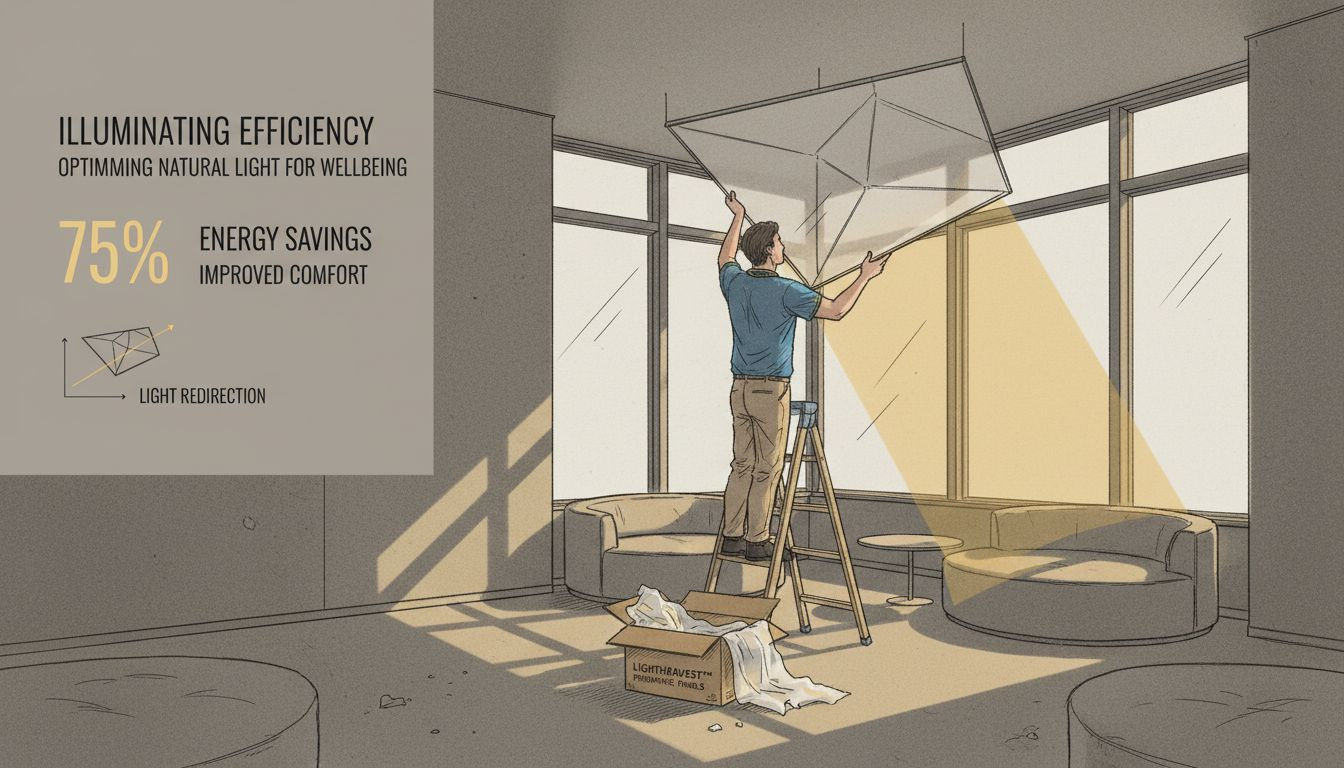
Different reflective panel technologies achieve light redirection through unique mechanisms. Some systems use angled surfaces to reflect light upwards and outwards, while others incorporate prismatic films that can split and redistribute light waves. Advanced panels can even filter specific wavelengths, reducing glare while maintaining optimal illumination levels. These technologies are particularly crucial in healthcare settings, where natural light has been proven to accelerate healing, improve mood, and create more therapeutic environments.
Pro Tip: Conduct a comprehensive site assessment to understand your specific architectural light dynamics and potential panel installation challenges before implementing reflective lighting solutions.
Energy And Health Impacts In Healthcare
Reflective lighting technologies are revolutionising healthcare environments by simultaneously addressing energy efficiency and patient well-being. High light reflectance and diffusion in ceiling panels can significantly enhance indoor environments, reducing energy consumption while creating spaces that positively impact occupant health and recovery. These innovative systems transform traditional healthcare lighting from a mere functional necessity into a strategic health intervention.
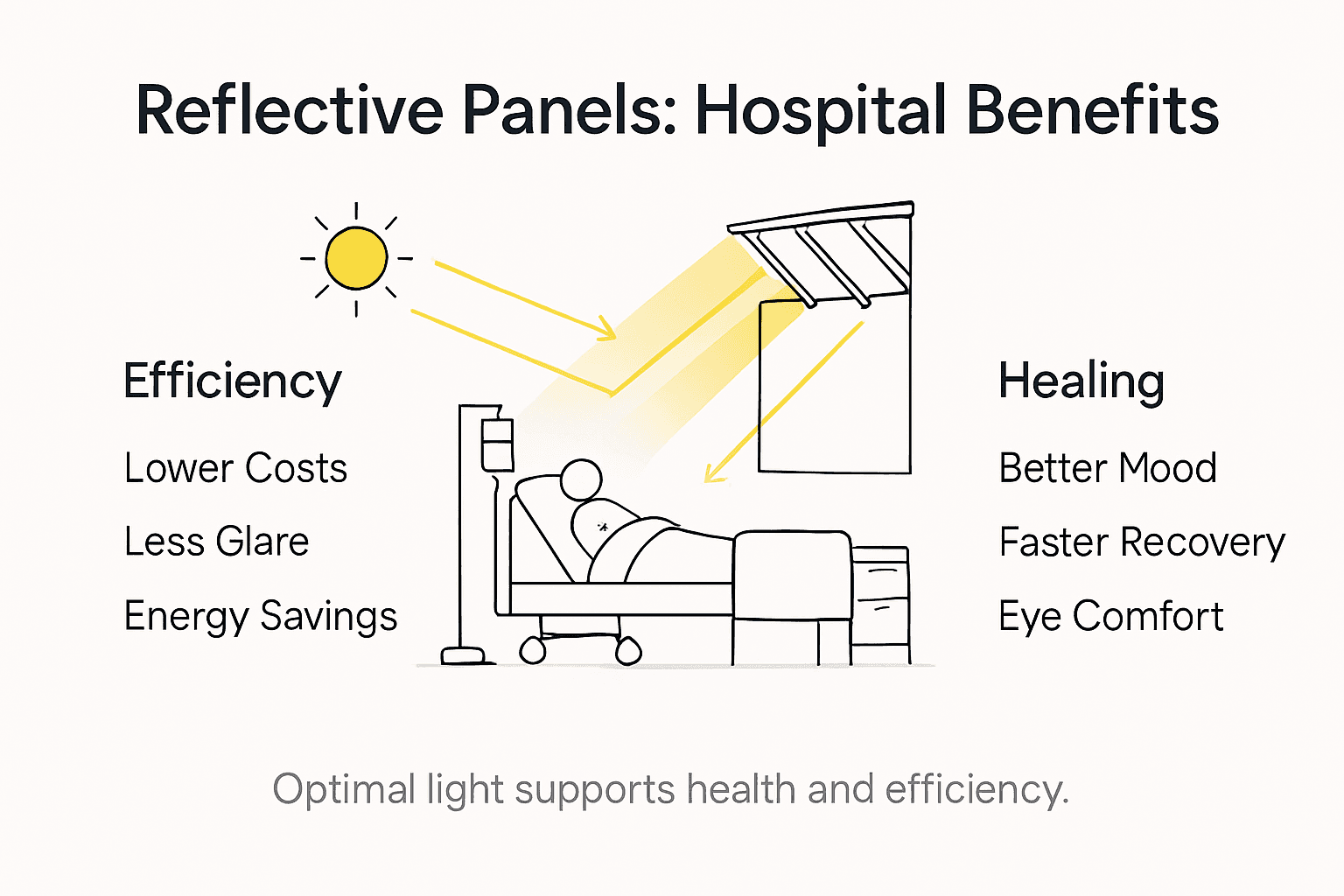
The spectral content of indoor lighting, influenced by advanced reflective surfaces, profoundly affects physiological processes, making lighting design a critical consideration in healthcare settings. Precise light manipulation can regulate circadian rhythms, improve patient mood, accelerate healing processes, and reduce stress levels for both patients and healthcare staff. By carefully controlling light wavelengths and distribution, healthcare facilities can create environments that actively support physiological and psychological recovery.
Energy efficiency intersects directly with health outcomes through intelligent reflective panel technologies. These systems not only reduce electricity consumption by maximising natural light utilisation but also create healing environments that support patient well-being. Advanced panels can decrease artificial lighting needs by up to 70%, generating substantial cost savings while simultaneously providing superior illumination quality that supports natural healing mechanisms. The dual benefits of energy conservation and enhanced patient care make reflective lighting an increasingly essential component of modern healthcare infrastructure.
Pro Tip: Implement a comprehensive lighting assessment that evaluates both energy efficiency metrics and potential health impacts before selecting reflective panel technologies for healthcare environments.
Design Requirements And Implementation
Designing effective reflective panel systems for healthcare environments requires a sophisticated approach that integrates advanced optical engineering principles. Engineered gradient metasurfaces enable precise control over light reflection and refraction, allowing healthcare architects to create multi-channel reflectors that can dynamically direct light across complex interior spaces. These innovative technologies transform traditional lighting design from a static solution to an adaptive, intelligent system that responds to changing environmental conditions.
Adaptive Reflective Technologies represent a breakthrough in lighting implementation. Tunable graphene-based reflective cells offer dynamic phase control of reflected light, providing unprecedented flexibility in managing illumination characteristics. Healthcare facilities can now implement reconfigurable reflectarrays that adjust light distribution based on specific clinical requirements, patient needs, and time of day. This level of precision enables designers to create environments that actively support healing processes by optimising natural light exposure.
Implementation of reflective panel systems demands a comprehensive approach that considers multiple critical factors. Healthcare facilities must evaluate architectural constraints, patient recovery zones, staff working environments, and energy efficiency goals. Key design requirements include seamless integration with existing infrastructure, minimal disruption during installation, compatibility with building management systems, and compliance with healthcare facility regulations. The most successful implementations involve interdisciplinary collaboration between lighting engineers, healthcare architects, medical professionals, and energy efficiency experts.
The following summary outlines key design considerations for successful reflective panel implementation in healthcare:
Design Factor | Importance | Example Consideration |
Integration with Infrastructure | Ensures compatibility with building systems | Fits existing windows and ceilings |
Patient Wellness | Maximises healing and comfort | Minimises glare in recovery zones |
Energy Efficiency | Reduces long-term running costs | Decreases artificial light usage |
Regulation Compliance | Meets healthcare construction standards | Certified safe for medical facilities |
Pro Tip: Develop a comprehensive site-specific lighting audit that maps current light distribution, identifies optimal reflection points, and creates a tailored implementation strategy for reflective panel technologies.
Potential Risks And Design Pitfalls
Improper spectral modulation of indoor lighting due to reflective surfaces can adversely affect physiological processes, making the design of healthcare lighting systems a critically nuanced endeavour. Poorly implemented reflective panel technologies can inadvertently create environmental conditions that disrupt patient circadian rhythms, increase stress levels, and potentially compromise recovery trajectories. Healthcare facility managers must recognise that light is not merely an aesthetic or functional element, but a complex biological signal with profound physiological implications.
Reflective panel implementation demands meticulous attention to energy conservation principles. Multi-channel reflector designs require careful consideration of energy reciprocity to prevent unintended light paths, which can lead to inefficient performance and unexpected thermal consequences. Common design pitfalls include excessive glare, uneven light distribution, and thermal absorption that can create uncomfortable or counterproductive healing environments. These risks are particularly pronounced in healthcare settings, where patient comfort and recovery are paramount.
Key risks in reflective panel technologies emerge from inadequate interdisciplinary collaboration and oversimplified design approaches. Potential challenges include inappropriate wavelength selection, insufficient consideration of patient-specific visual needs, and failure to account for varying clinical environments. Certain patient populations, such as those with neurological conditions or heightened light sensitivity, require extraordinarily sophisticated lighting interventions that generic reflective panel systems might not adequately address.
Pro Tip: Engage a multidisciplinary team including lighting engineers, medical professionals, and human factors specialists to conduct comprehensive risk assessments before implementing any reflective lighting solution.
Experience Healing and Efficiency with Advanced Reflective Panel Solutions
The article highlights critical challenges faced by healthcare facilities in optimising natural light while ensuring patient well-being and energy efficiency. Reflective panels use complex light redirection principles that can be difficult to implement without expert guidance. Key concerns such as glare reduction, spectral modulation, and architectural integration require precise solutions to create therapeutic environments that support recovery and reduce energy costs.
At LightMirror, we specialise in innovative reflective panel systems designed specifically for healthcare settings. Our proprietary technology leverages advanced physics and AI to dynamically optimise daylight entry, improving natural light exposure and reducing reliance on artificial lighting. Explore our proven projects like Healing Hill | LightMirror 2023 to see how our solutions transform hospital spaces. Take the first step towards a sustainable, health-promoting environment by visiting our main site at LightMirror today.
Ready to enhance your healthcare facility with cutting-edge reflective lighting? Discover how your project can benefit from tailored system design, expert installation, and ongoing support. Visit Healing Hill | LightMirror 2023 now and contact us to begin your journey to better healing environments and energy savings.
Frequently Asked Questions
What are reflective panels in lighting?
Reflective panels in lighting are advanced technologies designed to manipulate and optimise natural light within architectural spaces by redirecting, enhancing, and distributing sunlight effectively.
How do reflective panels benefit healthcare environments?
Reflective panels improve healthcare environments by maximising natural light utilisation, which enhances patient recovery, improves staff well-being, and reduces energy consumption by relying less on artificial lighting.
What types of reflective panels are commonly used in healthcare settings?
Common types of reflective panels used in healthcare include prismatic panels, mirror-based systems, optical films, and multifaceted reflectors, each offering unique advantages for light redirection and distribution.
What should be considered before implementing reflective panels in a healthcare facility?
Before implementing reflective panels, it’s essential to conduct a comprehensive site assessment to evaluate the specific architectural light dynamics, integration with existing infrastructure, and compliance with healthcare regulations.
Recommended
Comments